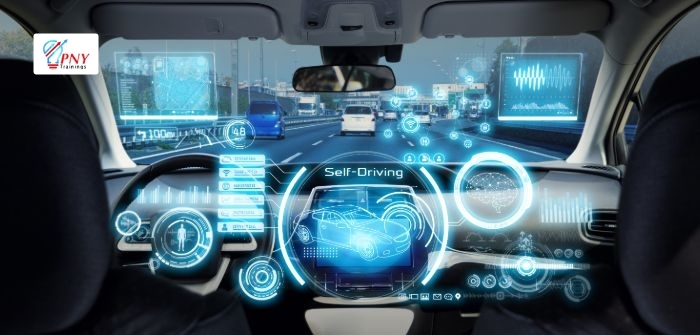
Autonomous Vehicle - A New Technology
An autonomous vehicle is one that can sense its surroundings and drive itself without the need for human intervention. It is not essential for a human passenger to take control of the car at any time or to be present in the vehicle at all. An autonomous vehicle can go anywhere as a typical car can go and perform all of the tasks that a skilled human driver would perform.
Working Mechanism
Some sensors, actuators, complex algorithms, machine learning systems, and powerful processors are used by autonomous vehicles to run the software. Based on a number of sensors located throughout the vehicle, autonomous vehicles develop and maintain a map of their surroundings. Radar sensors monitor the movement of nearby vehicles. Traffic signals are detected by video cameras, which also read road signs, monitor other vehicles, and look for pedestrians.
Lidar (light detection and ranging) sensors estimate distances, detect road boundaries and recognize lane markers by bouncing light pulses off the vehicle's surroundings. There is ultrasonic sensors present in vehicles to detect curbs and other vehicles while parking. After processing all of this sensory data, sophisticated software creates a path and provides directions to the car's actuators, which control acceleration, braking, and steering. The software follows traffic rules and navigates obstacles due to hard-coded rules, obstacle avoidance algorithms, prediction, and object detection and recognition.
Positive Urban impact
Autonomous vehicles may boost urban living and vehicle sharing by making taxi and public transportation services more inexpensive, increasing walking and bicycling conditions, and eliminating parking needs. As a result, total travel impacts are determined by the percentage of households who select urban over suburban or rural settings, as well as the percentage of households that share rather than own autonomous vehicles.
When Autonomous vehicles Will Be on Roads
Autonomous vehicles are still in the early stages of development and testing. Level 2 and 3 technology, such as cruise control, hazard warning, and automated parallel parking, are available on many modern automobiles.
Autonomous vehicle technology will need to go through several additional stages to become broadly commercially available, dependable, and economical, and hence widespread in the vehicle fleet. Vehicles have greater testing and regulation criteria than most other technology advancements, such as personal computers and mobile phones, because they might impose major external costs, like as congestion and crash hazards. Testing and licensing will take only a few years under ideal circumstances, but it may take longer if the technology proves to be unreliable and dangerous, such as if autonomous vehicles cause high-profile crashes.
Level 5 autonomous vehicles, if all goes well, will be safe and reliable by 2025. Testing and regulatory certification will take a few more years, but autonomous vehicles might be commercially available and allowed to operate in many locations by 2030. If they follow the pattern of previous vehicle technology, they will be expensive and limited in performance during the 2030s and likely the 2040s, and if possibly unable to reach the desired destination or requiring human interference when they encounter unexpected situations.
Potential Conflicts
In the design and programming of autonomous vehicles, there may be conflicts between the user and community interests. For example, if set to enhance passenger comfort, they may limit traffic speeds, whereas if programmed to protect occupants, they may increase the danger of other road users being involved in a collision. Some benefits (lower traffic and probably lower pollution emissions) necessitate dedicated autonomous car lanes, which raises problems about fairness, price, and enforcement.
Challenges
Lidar and Radar
Lidar is costly, and it is still attempting to find the optimal balance of range and resolution. Will numerous autonomous cars' LIDAR signals interfere with one another if they drive on the same road? Will the frequency range be sufficient to facilitate mass production of driverless automobiles if many radio frequencies are available?
Geographic Conditions
What happens if an autonomous vehicle is driving in heavy rain? Lane dividers vanish when there is a coating of snow on the road. When lane markings are hidden by water, oil, ice, or debris, how will the cameras and sensors track them?
Laws and Traffic Conditions
Will self-driving cars have problems passing through tunnels or across bridges? How will they fare in rush-hour traffic? Will self-driving cars be restricted to a single lane? Is it possible for them to use the carpool lane? What about the fleet of old cars that will be on the road for the next 20 or 30 years?
Autonomous vehicles in Pakistan
While some in the West are still doubtful of self-driving cars, the technology is spreading around the world. Master Changan Motors is believed to be putting in an all-out effort to bring the autos of the future to Pakistan.
Under Master Changan's goal of "Future Forward, Forever," the CEO also disclosed how the automaker is testing patented Artificial Intelligence-based autonomous driving technology. They're also attempting to adapt this technology to Pakistani roadways.
Changan Pakistan is putting Changan UNI-T through its paces. It is the first vehicle in the automaker's new "UNI" product series, which includes various future technologies. The future UNI-T is outfitted with an AI-chip-based intelligent vehicle system, resulting in a top-of-the-line human-machine interaction.
Adoption of autonomous vehicles
The adoption of autonomous vehicles is simply one of many developments that will have an impact on future transportation demands and impacts, and it is not necessarily the most important. Their long-term consequences are determined by how autonomous vehicles interact with other trends, such as the shift from private to shared transportation. Vehicles. During the majority of our lives, autonomous vehicles are unlikely to be a "game-changer. “This technology will only cause a "paradigm shift" if it results in substantial public-to-private transfers. More multi-modal communities are created as a result of shared automobiles.