Diploma vs Short Course vs Bootcamp: Which IT Learning Path Is Right for You?
Picking how to learn IT can feel harder than learning the skill itself. Diploma, short course, or bootcamp? Every institute offers all three, every option promises results, and most learners just want to know which one actually leads to a job or freelance income.
Here is the truth. The format matters far less than what you do inside it. A pattern we see in classrooms is that motivated students succeed in any format, while passive ones struggle even in the best program. That said, matching the format to your situation saves you time and money and keeps you motivated. This guide breaks down what each path really offers, how long each takes, what they cost in relative terms, and which one fits different goals. By the end, you will know exactly which path suits you.
What Is the Difference Between a Diploma, a Short Course, and a Bootcamp?
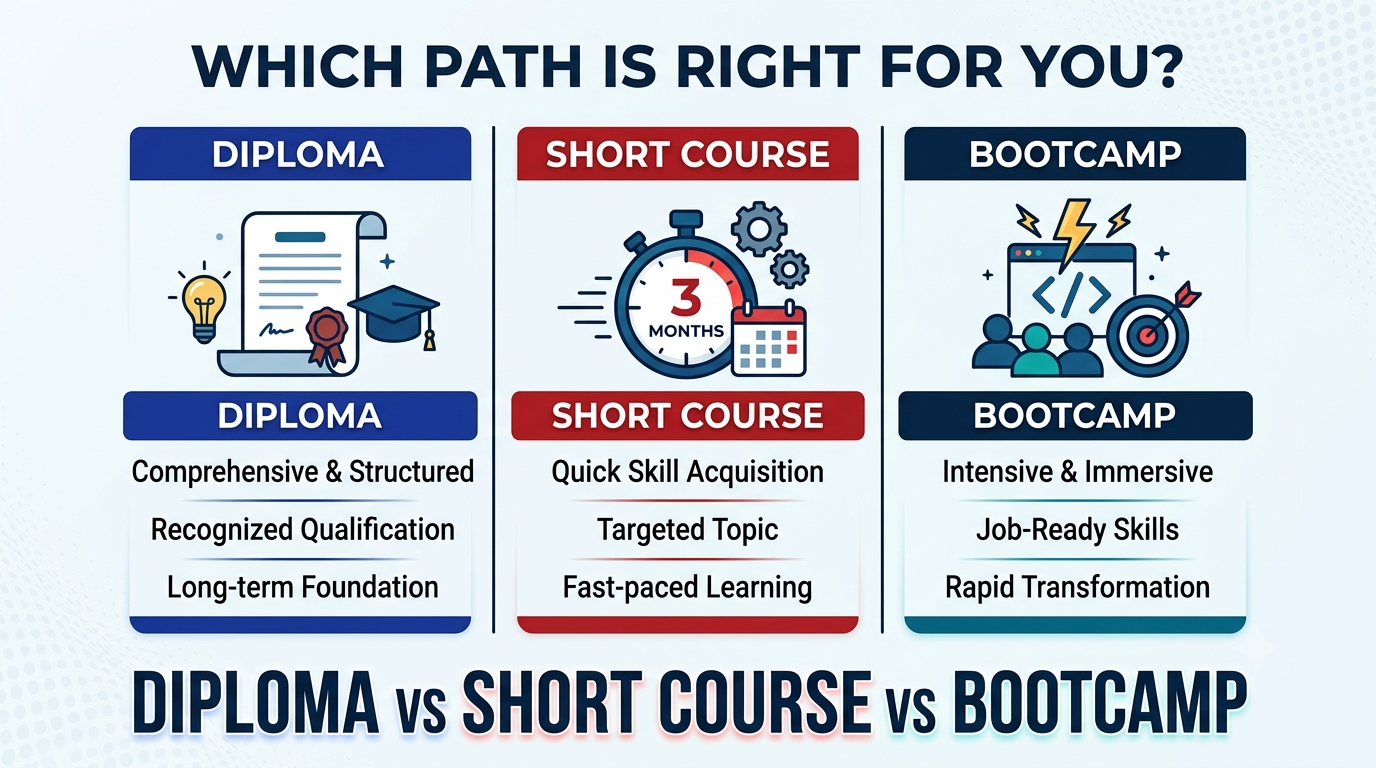
A diploma is a long, broad program covering a full field over several months. A short course is a focused program teaching one specific skill quickly. A bootcamp is an intensive, fast-paced program designed to make you job-ready in a compressed timeframe.
The core difference is depth versus speed versus focus. A diploma builds wide knowledge and a strong foundation, which suits complete beginners who want to understand a field properly. A short course zooms in on a single skill, perfect when you already know the basics and want to add one capability like Figma design or Google Ads. A bootcamp is the pressure cooker option. It compresses a large amount of learning into a short, demanding schedule with a heavy focus on projects and employability. When you actually compare outcomes, each format can lead to a job. The difference is the road you take to get there.
Which IT Learning Path Is Best for Beginners?
A diploma is usually best for complete beginners because it builds a broad foundation and does not assume prior knowledge. Bootcamps can also suit motivated beginners who want speed, while short courses work best once you already have some background.
Most students discover that starting with a diploma prevents the frustrating gaps that come from jumping straight into a narrow skill. When you understand the fundamentals of how software, networks, or data actually work, every later skill becomes easier to learn. However, a beginner who is highly motivated and can study intensely may thrive in a bootcamp instead, trading breadth for speed. If you want a structured beginner path across a full field, explore the diploma and specialization options in the PNY Trainings course catalog and pick the one closest to your target career.
How Long Does Each IT Path Take?
Diplomas usually take several months up to about a year, short courses take a few weeks to a couple of months, and bootcamps typically run for a few intense weeks to a few months. The timeline reflects how much ground each format covers.
A diploma spreads learning across a longer period, which suits people balancing study with other commitments. A short course fits neatly around a job because it targets one skill and finishes quickly. A bootcamp packs the most learning into the least calendar time, but it demands serious daily commitment, so it is not ideal if your schedule is already full. Be realistic here. Becoming job-ready in any format still requires practice beyond class hours. What most articles miss is that the calendar length matters less than the total effort you put in.
Which Path Gives the Best Value for Money?
Short courses are usually the most affordable, diplomas cost more because they cover more over a longer period, and bootcamps sit in between while focusing heavily on job outcomes. The best value depends on your goal, not just the price tag.
Value is about outcome per rupee, not the lowest fee. A cheap short course is great value if it teaches the exact skill you need to start earning. A diploma costs more but can deliver better long-term value by opening a whole field rather than one skill. A bootcamp aims to justify its cost through speed and employability support. Because fees change over time and vary by course, always check the current price and what is included on the specific course page before deciding. For exact and up-to-date fees, visit the relevant course listing on the PNY Trainings website.
Which Path Is Best for Getting a Job or Freelancing Quickly?
Bootcamps are usually best for getting job-ready quickly, because they concentrate on practical projects and employability. Short courses are ideal for starting freelancing fast in one skill, while diplomas suit those building toward a longer-term career with deeper knowledge.
If your goal is to start earning as soon as possible, a bootcamp or a focused short course gets you there faster than a long diploma. In practice, freelancers often succeed with a single strong skill learned through a short course, then build from client work. Job seekers targeting companies sometimes benefit from the broader foundation and internship support that come with diplomas. Whichever you choose, remember the honest limitation. A certificate alone does not land the job or the client. A portfolio of real projects does, and that is what turns any of these formats into income.
Comparison Table: Diploma vs Short Course vs Bootcamp
Factor | Diploma | Short course | Bootcamp |
Duration | Several months to a year | Weeks to a couple of months | Few weeks to a few months, intensive |
Depth and scope | Broad, covers a full field | Narrow, one specific skill | Focused and practical, job oriented |
Best for | Complete beginners wanting a foundation | Upgrading or adding one skill | Fast job readiness and career switchers |
Pace and commitment | Steady, manageable alongside other work | Light and flexible | High, demands daily effort |
Relative cost | Higher | Lowest | Moderate to higher |
Typical outcome | Strong all round foundation | One job or freelance ready skill | Portfolio and job readiness quickly |
Use this as a decision map. Match the row that matters most to you, then pick the column that fits.
How to Choose the Right IT Path for You
Choose based on three things: how much time you can commit, your starting knowledge level, and your goal. Beginners wanting depth pick a diploma, people adding one skill pick a short course, and those wanting fast job readiness pick a bootcamp.
Ask yourself where you are starting from and where you want to be in six months. A fresh beginner aiming for a development career is well served by a diploma. Someone with a marketing background who wants to add data analytics is better off with a short course. A career switcher who wants to move into tech quickly and can study hard should look at a bootcamp. As a result, the right choice is personal, and there is no universally superior format. The best path is the one you will actually finish and build on. Skills like web development, digital marketing, data science, and cybersecurity are available in all three formats, so you can match the skill to the format that fits your life.
Conclusion
There is no single winner between a diploma, a short course, and a bootcamp. A diploma builds the deepest foundation, a short course delivers one skill fast and affordably, and a bootcamp gets you job-ready quickly through intense, focused effort. The best path is the one that matches your available time, your starting knowledge, and your goal, and the one you will genuinely commit to finishing. Remember that any format only works when you back it with real projects and steady practice.
For broader guidance on recognized qualifications and skills training in Pakistan, the Higher Education Commission, the National Vocational and Technical Training Commission, and the government skills initiative DigiSkills offer useful information and resources.