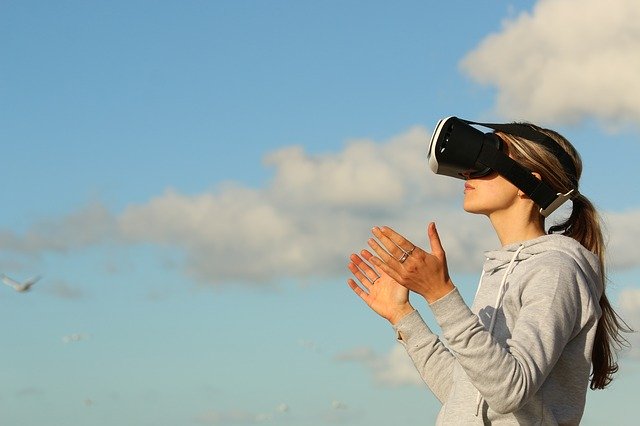
What is VR?
Virtual reality (VR) is a new user interface unlike the conventional , immersing a person in 3D environment, instead of watching on a display. Computer-generation & content aim at simulating a presence through senses.
Virtual reality simulation requires two main components: a source of content and a user device. Software and hardware, in other words. Currently, such systems include headsets, all-directions treadmills, special gloves, goggles. VR tools provide realistic, natural, high quality images and interaction possibilities. For this, devices rely on measurements like:
- image resolution
- field of view
- refresh rate
- motion delay
- pixel persistence
- audio/video synchronization.
The main challenge of VR is tricking the human brain into perceiving digital content as real. That is not easy, and this “immersion” issue is what still holds virtual reality experiences back from being enjoyable. For example, the human visual field doesn’t work as a video frame, and besides about 180 degrees of vision, we also have a peripheral vision. Yet, the VR visionaries are confident of overcoming such issues sooner or later, campaigning for the concept and collecting investments in millions. The virtual experience like VR apps and games are already available. There’s a good enough choice of headsets.
How does virtual reality work?
Currently, VR headsets receive input from two different sources: an HDMI cable that is either connected to a PC or console or a smartphone. The former applies to headsets such as the HTC Vive and the Oculus Rift, while the latter is used with Google’s Daydream and Samsung’s Gear VR headsets. You can also connect other devices—such as head and hand tracking, controllers, and voice input—to your VR headset.
Once you’re ready to use your VR headset, here’s what happens inside of it:
There are either one or two screens per eye that receive two feeds, as well as autofocus lenses that are positioned between your headset’s screen and your eyes. These can be adjusted depending on both eye movement and positioning. Their other functions include picture focusing and reshaping for each eye, and tilting two 2D images to produce a stereoscopic 3D image that emulates how our eyes view the world.
Several VR headsets have minimum 100- or 110-degree field of view for a more immersive VR. As for the image produced by these devices, a minimum frame rate of 60fps is required to make convincing without making the user feel sick.
As mentioned, Virtual requires several devices such as headset, computer, smartphone or another machine to create a digital environment, and a motion-tracking device in some cases. Typically, a headset displays content before a user’s eyes, while a cable (HDMI) transfers images to the screen from a PC. The alternative option is headsets working with smartphones, like Google Cardboard and Gear VR – a phone that acts both as a display and a source of VR content.
Some vendors apply lenses to change flat images into three-dimensional. Usually, 100/110-degree field sight is achieved with VR devices. The next key feature is the frame rate per second, which should be 60 fps at a minimum to make virtual simulations look realistically enough.
For user interaction there are several options:
Head tracking
The head tracking system in VR headsets follows the movements of your head to sides and angles. It assigns X, Y, Z axis to directions and movements, and involves tools like accelerometer, gyroscope, a circle of LEDs (around the headset to enable the outside camera). Head tracking requires low latency, i.e. 50 milliseconds or less, otherwise, users will notice the lag between head movements and a simulation.
Eye-tracking
Some headsets contains infrared controller that tracks direction of your eyes inside a VR environment. The major benefit of this technology is to get more realistic and deeper field of view.
Motion tracking
Though not engineered and implemented well enough yet, motion tracking would raise Virtual reality to a totally new level. The thing is, that without motion tracking you’d be limited in VR – unable to look around and move around. Through concepts of the 6DoF (six degrees of freedom) and 3D space, options to support motion tracking fall into 2 groups, optical and non-optical tracking. Optical tracking is typically a camera on a headset to follow the movements, while non-optical means the use of other sensors on a device or a body. Most of existing devices combine both options.
Without a doubt, Virtual Reality could become the transformative technology one day, though not tomorrow or the next month. The experience of wearing a headset and immersing in virtual worlds is still a new genre unexplored by customers. Well, at least Mark Zuckerberg described enthusiastically what VR is when buying out Oculus in 2014. “Imagine a courtside seat at a game, studying in a classroom of students and teachers all over the world… just by putting on goggles”.
The technology is exciting, though it still has to deliver much more on the hardware and software fronts to gain traction. Virtual reality challenges include missing engaging content, overcoming ‘nausea’ problem, high cost, the imprudence of cables and devices on ahead. On the other hand, many entrepreneurs and tech fans are super-thrilled about VR, expecting it to grant out-of-body experiences.
What are the uses of virtual reality?
Virtual reality is present in numerous fields, such as entertainment, marketing, education, and medicine although gaming stills one of the most popular uses for the technology. For instance, military forces use VR for flight, battlefield, and vehicle simulations, as well as medicine training and VR boot camp. It also helps them reduce training costs and recreate training.
VR is widely utilized in both mental health and medical training, and is used to treat post-traumatic stress, anxiety, phobias, and depression. Both medical and dental students have taken advantage of this technology, as it enables them to practice surgeries and other procedures.
In the field of education, VR provides students to interact with each other in 3D environments. Museums, the solar system, and time periods can be “visited” remotely with the help of VR. The technology can also encourage children with special needs to practice their social