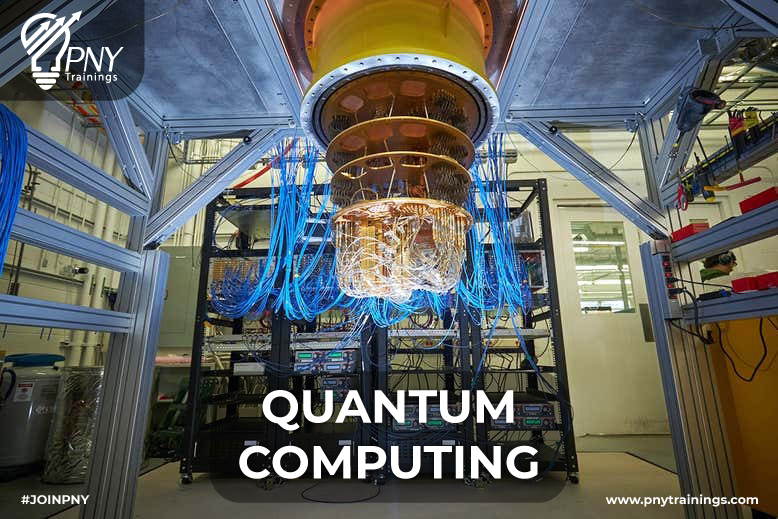
In theory and practice, today's computers are based on classical physics. Locality (operations have only local effects) and the traditional reality that systems may only be in one state at a time limit them. Modern quantum physics, on the other hand, tells us that the world works in a very different way. A quantum system is a system that has quantum properties. At the same time, it can be in a superposition of many different states and display interference. During the course of its evolution, it has had a variety of consequences. Furthermore, quantum systems that are geographically separated may be entangled with one another, and activities may have "non-local" consequences as a result.
What is Quantum Computing?
Quantum computing is a branch of science that studies the computational capability and other characteristics of computers using quantum-mechanical concepts. It brings together two of the most important branches of twentieth-century science: quantum physics and computer science. Finding quantum algorithms that work is an essential goal are far faster than any conventional approach for solving the same problem.
Quantum computers come in a variety of shapes and sizes, but they all work on the same principle: they contain a quantum processor that allows engineers to isolate quantum particles for manipulation. From one quantum computing approach to the next, the nature of those quantum particles, as well as the technology used to manage them, differs. Some methods need the CPU to be cooled to subzero temperatures, while others use lasers to play with quantum particles - all with the purpose of figuring out how to best leverage quantum physics' usefulness.
How does it work?
After knowing what is Quantum Computing? The very first question that arises is how does it work? Quantum computers, in contrast to classical computers, execute calculations based on the probability of an object's state before it is measured, rather than only 1s or 0s, allowing them to process exponentially more data. Instead, operations in quantum computing utilize the quantum state of an item to produce a qubit. These are the undefined qualities of an object before they are discovered, such as an electron's spin or a photon's polarization. Unmeasured quantum states exist in a mixed ‘superposition' rather than having a definite position, similar to a coin spinning through the air before landing in your hand.
These superposition’s can get entangled with those of other objects, implying that their final outcomes will be mathematically connected, even though we don't know what they are yet. Solving complex mathematical problems, creating difficult-to-crack security codes, and forecasting numerous particle interactions in chemical reactions can all benefit from such algorithms.
Why are quantum computers faster?
Quantum computers can represent these enormous issues in massive multidimensional spaces created by quantum computers. This is something that traditional supercomputers are incapable of. Quantum wave interference algorithms are then utilized to locate solutions in this realm and translate them back into usable and understandable forms.
Quantum computing benefits
Quantum computers, when used appropriately, are extraordinarily fast and effective. They can conduct calculations that today's supercomputers would take decades or perhaps millennia to complete. Quantum supremacy is a term used by specialists to describe this occurrence. This was only a theory for a long time. Google's quantum computer prototype, on the other hand, was able to do such a calculation and demonstrate quantum superiority in practice in 2019.
Quantum computer benefits in calculations are especially promising for analyzing or simulating extremely complicated processes with large volumes of data. Natural science fields, in particular, see the significant potential here, in addition to digital marketing. Quantum computers may help researchers gain a better and more detailed understanding of how specific particles, components, and processes interact in live cells. However, there are possible medical applications.
Most importantly, experts believe quantum computers' benefits are they will advance artificial intelligence (AI) significantly. In the future, they could safely and reliably take over jobs like data evaluation and forecasting.
Need for Quantum technology in Pakistan
Even though it is understandable for the education minister, Shafqat Mehmood, to be pleased with the increased education budget, as we want to see Pakistan become a technologically advanced country, would be happier and more satisfied if some of the funds were used to develop a national research program. The major goal of such a program would be to establish the groundwork for a thriving knowledge-based economy in the United States. Such a program, which would have accelerated Pakistan's Nanotechnology revolution through industry-academic collaborations should have been established decades ago. Pakistani QIS specialists and those working abroad can be used to help advice on precise work packages with distinct short, medium, and long-term goals. If designed, this program should have short schedules, hard yet achievable deliverables, and key performance indicators. If we pool our collective intellectual capital, we will be able to make rapid progress in this new field of quantum technology.
Short- and long-term gains in the rankings of Pakistani institutions strengthened industry-academic cooperation, and better-skilled academics and graduates are the bare minima that can be achieved with a national QIS program. And, rather than being a consumer nation, the ideal scenario would be a knowledge-based economy capable of developing future technologies at home.
Future of Quantum computers in Pakistan
There is an urgent need in Pakistan to develop a critical mass of professionals in this field, and we must make it a national priority. Cybersecurity, artificial intelligence, cloud computing, robots, and other areas of expertise have already been formed. Regrettably, they are not guided by a unified national agenda. It is critical that a quantum computing center of excellence be built. It must create strong collaboration links with the rest of the centers of excellence both internationally and locally in order to be effective. There are institutes that are offering quantum computer courses in Pakistan is providing the basic information and looking forward to the bright future of Pakistan.